If you compare vintage and new designs among Omega's water-resistant men's watches, the sheer range is overwhelming. Since 1948, the Omega Seamaster has been one of the most important dive watches of all. Ready for a trip back in time? Let's go!
A sensational start, but in the wrong year...
When Omega presents its early models built for underwater missions, it begins with the legendary Marine. An extendable bracelet, a square shape and a double case with a sliding mechanism that concealed the crown: developed in 1932, this tool watch was packed with clever solutions and even passed impressive functional tests. Professional divers squeezed into their bulky suits to prove its water resistance at a depth of 73 meters in Lake Geneva. Ocean researchers applauded. Otherwise, the response was muted, because the general public didn't see the point.
The brand's 100th anniversary and the birth of an icon
A few years later, sporty wristwatches struck a chord with the times. Military operations had shown that even air forces could not rule out contact with water, and a timepiece needed to survive it. The same idea applies to everyday life, and in 1948 it gave rise to the sports watches recognizable today by the seahorse on the caseback. The robust case, the sturdy lugs, the bold indices and numerals: all of it served function, yet for watches of that era it was also aesthetically unconventional. Equally striking was the contrast between the sporty design elements and the refined character of this water-resistant legend.

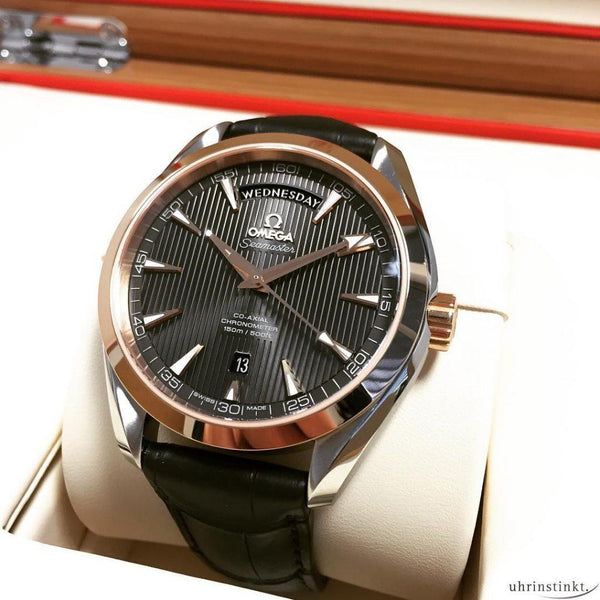
Vintage originals are rare and technically outdated. That's why Omega beams its old Seamaster automatic watches into the present – for example with the Co-Axial Master Chronometer 1948. This homage stays true to the postwar design but incorporates the latest watchmaking technology. Case and dial in platinum, indices and hands in gold: the choice of materials hints that this nostalgic statement doesn't come cheap. The Seamaster was well received at its debut because it was made for the challenges of air, land and sea. For some years now, the Omega models of the Aqua Terra family have built on this winning versatility.


The leap from water-resistant timepiece to first true dive watch
When recreational divers with a soft spot for great timepieces spot this Omega Seamaster in the model lineup, their hearts beat faster: in 1957, the icon introduced a new type of crown gasket and a specially sealed, remarkably thick crystal. Its developers also thought through the finer points of safety: the diving bezel was designed so it couldn't be turned by accident. The name of Omega's first watch for professional diving was "Seamaster 300", which is misleading: its water resistance was rated not to 30 bar but to 20 bar. The same was true of the second edition in 1963, whose improvements included a luminous bezel.

Apart from varying hand shapes, the dive icon stayed true to its look for many years. So that fans of this design classic don't have to resort to vintage pieces, the Seamaster 300 is also part of the current lineup – as a chronometer with Caliber 8912 and 30 bar water resistance. As part of the anniversary edition, a handsome version in summery ocean blue joined the range in 2023.


Tool watches that aren't afraid of the deep
Looking at vintage Omega Seamaster models, one thing becomes clear: the brand focused on improving the technical setup for professional use. To that end, it was also willing to pursue unusual ideas. The Bullhead, with its asymmetrical case and controls at 12 and 6 o'clock, was originally developed for rally racing.

Besides the pressure of deep-sea diving, a critical functional risk is the penetration of helium atoms. On extreme expeditions beneath the surface, even the smallest malfunction can be life-threatening. With the Seamaster Ploprof, Omega therefore set all aesthetic considerations aside and concentrated on deep-sea capability – with a monobloc case, a bezel lock with a red pusher and a locking nut on the crown. The result was a water resistance system rated to 600 m at the time, and to as much as 1,200 m in newer versions. Among Omega's men's watches, vintage models with an eccentric look are in demand. Accordingly, the Bullhead and the Ploprof still enrich the brand's portfolio today.


In 1976, Omega achieved its big breakthrough in pressure resistance: aesthetically, it took its cue from the first dive watch but kept the Ploprof's left-hand crown position. New were not only the curved "Pilot Line" case but also this Seamaster's water resistance to 1,000 m. It remained unsurpassed until 2009 and was spectacularly outdone in 2019 by the Planet Ocean Ultra Deep.


On a world-record dive, it ventured with Victor Vescovo to the deepest point of the Mariana Trench. Since 2022, this expedition watch, rated to 600 bar, has been part of the regular collection. Don't need quite that much? Then a Planet Ocean dive watch, water-resistant to 600 m, is a convincing choice.


James Bond's favorite watch – the Omega Diver
The timeline reveals that Omega took a breather from dive watches before making a big comeback in 1993 with a new collection. Anyone familiar with vintage Omega Seamaster automatic models will object immediately: in fact, it debuted some 20 years earlier, when the Diver 120m was introduced as the first chronograph suitable for underwater use. The brand built on that sensation, added a stylish look and gave the sports watch both a helium escape valve and 30 bar water resistance.
Since then, the Diver has enjoyed a large fan base, which is why there are many old and new versions with the wave pattern on the dial. The collection includes classic dive watches as well as chronographs – where even discerning secret agents find what they're looking for.

James Bond has been loyal to the dive watch since 1995 and received the Omega Seamaster Diver 300m as a new model: it impresses with a retro look and appeared in the 2021 spy film "No Time to Die".

An Omega Seamaster overview that covered every vintage variant...
...would go on forever. Scroll through the "vintage museum" on the brand's website and you won't believe your eyes. There are so many old models that even Omega can only sketch some of them. To date, more than 300 calibers have been fitted in these dive watches. Omega regularly introduces a new model of the Seamaster Diver 300m, and the same goes for the Aqua Terra. Variety is a key to the Omega Seamaster's success, for vintage models and new releases alike. The flip side of the coin: a model history that would fill thick books.