« Luxury with Added Value »
Mechanical wristwatches are fascinating feats of engineering, and the products of renowned luxury manufactures in particular achieve impressive precision. But for this to be possible and for the watch to run reliably, it has to be protected against various disruptive influences. That is why watchmakers began early on to make wristwatches water-resistant, shock-resistant, and antimagnetic. This article explores what antimagnetic watches actually are and what practical benefits they offer.
Magnetic Fields: The Invisible Disruptor
Magnetism is a phenomenon most people know from everyday life, yet it still remains somehow mysterious. Without special measuring instruments, it can usually only be detected in practice by the force a magnetic field exerts on metal objects. Magnetism occurs in magnetic or magnetizable objects, but also in connection with electric charges. Every movement of an electric charge, for example, generates a magnetic field – such as around power lines or electrical devices, especially speakers, microphones, cell phones, or computers. It stands to reason that something as complex and at the same time as delicate as a mechanical movement is sensitive to forces acting on it from outside.

But while hardly anyone would be surprised that a watch can be damaged by a knock or an impact on a hard surface, this is less obvious when it comes to magnetic forces. After all, they are invisible and cause no damage that is apparent from the outside at first glance. Nevertheless, magnetic forces can disrupt the normal running of mechanical movements, impair their accuracy, and in the worst case even damage a movement. For this reason, watchmakers began early on to address the question of how movements could be shielded from the disruptive effects of magnetic fields – and how so-called antimagnetic watches could be built.
Antimagnetic Watches: Milestones in Their Development
 What was probably the first watch protected against the influence of magnetic fields was introduced by Vacheron Constantin as early as 1915, but it was not a wristwatch. The first wristwatch with magnetic protection is said to have been a Tissot watch in 1925.
In the years that followed, antimagnetic properties increasingly became a key quality criterion for mechanical timepieces – just like accuracy, shock resistance, and water resistance.
After World War II, several watchmakers, including IWC, Omega, and Rolex, produced special models that not only offered general protection against magnetic fields but were also shielded against the particularly strong magnetic fields that people in certain professions – such as doctors, engineers, mechanics, or scientists – were exposed to at work. It is worth noting here that while quartz watches are less sensitive to magnetic fields, the hand-setting mechanism of a quartz watch with an analog display can certainly be affected.
How Are Antimagnetic Movements Made?
There are basically two different ways to make antimagnetic watches:
- First, a movement becomes less susceptible to magnetic forces if as few ferromagnetic components as possible are used in its construction. This is one reason why many watchmakers today use balance springs made of non-magnetic materials, such as silicon or Glucydur.
- Second, the movement can be enclosed in an inner case made of soft iron that shields it from magnetic forces. This approach is chosen above all for timepieces that are exposed to strong magnetic fields every day.
To this day, leading manufactures keep making new attempts to render mechanical wristwatches particularly resistant to magnetic fields.
The Rolex Milgauss: The Lightning-Bolt Seconds Hand Is Its Trademark
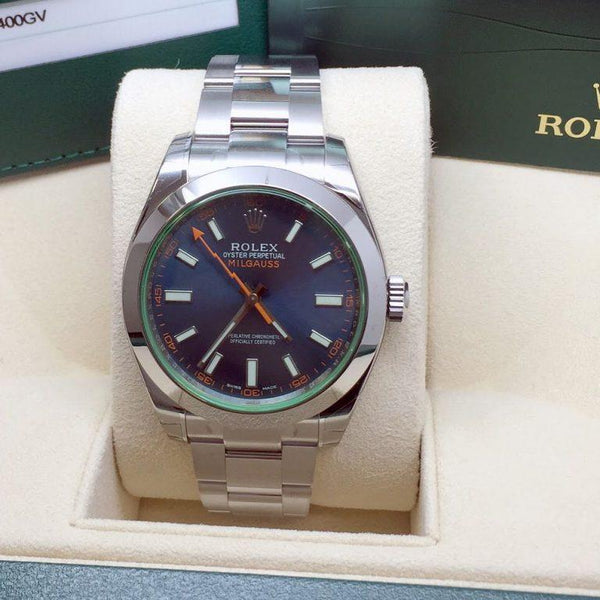
One of the most distinctive representatives of the antimagnetic watch category is the Rolex Milgauss – and has been for more than half a century. Among hundreds of other wristwatches, this model can be recognized at a glance by its striking seconds hand, which stands out not only for its orange color but also for its lightning-bolt shape. Its name combines the French word "mille" for "thousand" with the unit gauss, which is used to measure magnetic flux density and is named after the famous German mathematician, geodesist, astronomer, and physicist Johann Carl Friedrich Gauss (1777-1855).
The name thus also alludes to the watch's antimagnetic properties: it can withstand far stronger magnetic fields than conventional mechanical watches, which can already be disrupted by a field of 50 or 100 gauss. The Rolex Milgauss thus became a watch especially popular with scientists, researchers, engineers, and doctors. Thanks to its distinctive dial and hand design, it remains highly recognizable to this day. In its robust stainless steel Oyster case, its movement is also well protected against mechanical impacts and moisture.


The chronometer-certified movement is protected from magnetic fields by a special shield. The Milgauss is available with a black or blue dial. A particularly original touch is the version with a green sapphire crystal.
Record-Breaking Antimagnetic Watches in the Omega Seamaster Aqua Terra Collection
In 2013, Omega – which had already launched a highly antimagnetic model, the Railmaster, back in the 1950s – set another milestone in this segment. The Omega Seamaster Aqua Terra 15,000 Gauss stands out because its entire movement is made of non-magnetic materials. This allows the watch to retain high resistance to magnetic fields even with a sapphire caseback, which would not be possible with other models that rely on an antimagnetic inner case.

Much like the Milgauss, the current record holder among antimagnetic timepieces can also be identified by its seconds hand. While its shape is nothing unusual, it features a striking black-and-yellow color scheme that sets the model apart at a glance from similar sister models and other Omega Seamaster watches.