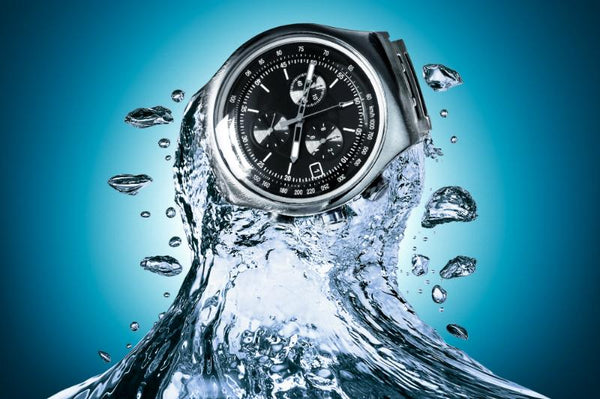
« What Do Bar, Meters and ATM Mean? »
When watchmakers specify water resistance, three units of measurement compete with one another. And laypeople rightly ask: isn't it irrelevant for everyday life that you could dive down to 100 meters if your wristwatch is water resistant to, say, 10 ATM or only 5 ATM? A little background knowledge delivers that "aha" moment and gives you a feel for which level of water resistance suits your personal lifestyle.
A Labor of Love for the Movement – Protection Against Water Pressure
When a movement gets wet, it is damaged at the very least. If high pressure forces the crystal loose or pushes movement components out of position, the timepiece is ruined. These facts make a strong case for designing wristwatches to be water resistant as a matter of principle. Special design concepts and materials prevent moisture from penetrating the case. Inexpensive fashion watches advertised as splash-proof stop at that. They won't give up the ghost the moment they meet a few raindrops, but they remain extremely averse to water.
The higher the water column, the greater the force bearing down on the wristwatch and its seals. Water resistance therefore correlates with pressure resistance, which is determined by standardized test procedures. The unit "atmosphere" lends itself to communicating the test results; its abbreviation appears in the manufacturer's specification "water resistant to 5 ATM" and is widely used in product descriptions.

The Focus of Testing: Pressure Loads from Water Columns
In science, "ATM" is considered outdated. The preferred unit for physical pressure is the "bar," which derives from the ancient Greek word "barýs" (heavy). From a layperson's perspective, the terms all describe the same thing: if you submerge an object 10 meters deep in water, it is subjected to a force of roughly 1 kilogram per square centimeter – exerted by the column of water above it.
So if a wristwatch withstands the force of 50 m of water depth, it is water resistant to 5 bar or 5 ATM. Incidentally, not only overpressure but also negative pressure can damage the movement or shatter the crystal. Specialist watches for air forces must therefore offer a high degree of resistance to negative pressure.

Watch brands tend to express water resistance as a certain diving depth in meters. This sets the stage for a common misconception: the feature doesn't matter if you never wear your masterpiece for water sports. The experts' short answer: Oh yes, it does!
A Forward-Thinking Feature for Everyday Watches – Is 5 ATM Water Resistant?
Provided the plumbing is perfectly adjusted, water flows from the faucet at 2 to 3 bar. But it's not unusual for it to trickle out due to low pressure or to gush out with more force. If you want to be on the safe side, you should rely only on timepieces water resistant to 5 ATM even when washing your hands. The same applies if you get caught in a heavy downpour on a walk.
Many elegant masterpieces are limited to this level of protection because they are intended more for the business day or special occasions. Take note: the men's models of a watch family are often water resistant to 10 ATM, while the women's versions are rated to only 5 ATM – for example, the Alpine Eagle sports collection from watch manufacture Chopard and the classically elegant everyday watches of the Frederique Constant Highlife line.


Elegance vs. Water Resistance
Case sealing takes up space and, depending on its extent, affects the design anywhere from slightly to significantly. In jewelry watches or complicated manufacture watches, there's simply – to put it casually – no room for it, which is why they are often water resistant to only 3 ATM. That level of protection is enough for rain splashes or perspiration. Otherwise, contact with water should be avoided. A popular example is the Royal Oak by Audemars Piguet. The legendary sports watch is water resistant to 5 ATM in its classic versions, while the Grande Complication editions are protected to only 20 m.

Advisable for Many Leisure Activities – 10 ATM Water Resistance or Specialist Watches
When swimming, you don't dive deep into the pool, but your body movements increase the load the pool water exerts on the watch case. According to tests, it is roughly comparable to a 100-meter water column. If you enjoy a varied range of leisure activities, you therefore need a wristwatch that is water resistant to at least 10 ATM. That doesn't necessarily mean you have to choose from sports collections. Befitting its pioneering role in water resistance, it is brand standard that Rolex collections are water resistant to at least 10 ATM. The same goes for its sister brand Tudor.

If you'd like a youthfully elegant automatic watch with the same robustness, take a look at the Nomos Club Campus .


100-Meter Water Resistance for Snorkeling
In principle, 100-meter water resistance is also sufficient for snorkeling or the occasional short dive. However, the forces from sudden movements and varying depths can add up. For an active beach vacation, robust sports watches that are not just water resistant to 10 ATM but can handle 20 bar are therefore the more sensible choice.
Other leisure pursuits deserve consideration too, the volunteer fire department being one example. Fire hoses typically operate at 17 bar. Volunteer firefighters therefore like to wear dive watches or special tool watches with high water resistance and temperature resistance – from Sinn, for example.


Related, but Not the Same – Water Sports Watches and Dive Watches
Just because a timepiece is water resistant to 10 ATM doesn't automatically mean you can take it on diving expeditions 100 meters below the surface. The test result refers only to pressure resistance and leaves out other stresses that makers of true dive watches take into account. The gasket materials in particular must be resistant to saltwater and suitable for a wide temperature range. The duration of the underwater expedition also matters for functionality.
In saturation diving, you have to bear in mind that helium molecules that have penetrated the case can exert pressure from within. This risk is eliminated by the helium escape valve, which on many professional tool watches opens automatically if the internal case pressure becomes too great. Examples developed explicitly for underwater adventures include the sporty Seamaster Diver 300 M and the professional Planet Ocean 6,000 m from Omega's Seamaster family.


Caution: Water Resistant Today, Splash-Proof Tomorrow and Eventually Water-Averse
When a premium brand guarantees that its watch models are water resistant to 10 ATM, you can rely on that at first. After that, watch care determines whether it stays that way. Chemicals in household cleaners can attack sealing components just as perspiration or salty seawater can. It's important to clean your watch after such contact.
Various environmental factors degrade the effectiveness of gasket materials, with the upshot that the 10 ATM wristwatch is eventually water resistant to only 5 ATM and ultimately not protected at all. For this reason alone, you shouldn't skip regular servicing – and only qualified experts should be considered for it. The same applies to battery changes on quartz timepieces, because improper handling can make water resistance vanish into thin air.