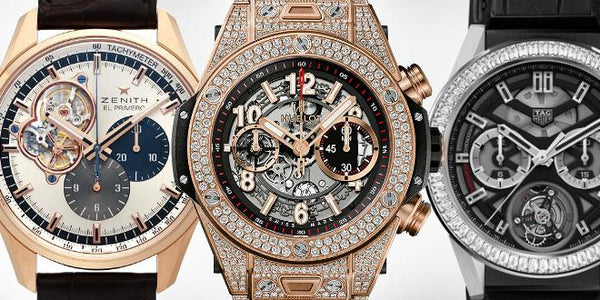
« Portrait of a Luxury Watch Management Legend »
He is regarded as one of the saviors of the mechanical watch and celebrated as a genius of modern marketing. Born in Luxembourg in 1949, Jean-Claude Biver, who made Switzerland his adopted home, has left his mark on modern horology like no one else. As head of the watch division at the LVMH group and CEO of TAG Heuer, he has now also been directly responsible for Zenith watches for a few months. The group-owned watch brand had fallen somewhat behind in recent years.
The Courage to Lead
It was a short-notice decision, Biver says today: while on vacation, he spontaneously decided to take over operational management at Zenith. Just a few years ago, of course, Biver wanted to slow down. That is no longer an option for the man reverently called the doyen of the watch industry. Looking back, Jean-Claude Biver explains that he made the decision out of frustration. He was responsible for three watch brands. One of them, TAG Heuer, had just closed 2016 as its most successful year in terms of revenue since its founding in 1860. Hublot, the second brand, posted a record year over the same period. Why can't Zenith do the same, he asked himself, before stepping into the breach to lead the brand personally.
It must be that special strength for leadership, which Jean-Claude Biver developed as a boy during his years at boarding school, that has now driven him back to the top once again. For the retirement-age manager, who had to look after his brother at boarding school after his parents separated, strength and responsibility are two cornerstones of a fulfilling life. But without courage, Biver is convinced, life's challenges cannot be mastered.
No Success Without Risk
Biver finds it a pity that so many people today lack precisely this courage to take risks. He himself has never shied away from a gamble in his life. Together with movement manufacturer Jacques Piguet, he bought the brand rights to Blancpain watches in 1981. At barely over 30, he put 22,000 francs on the table for a company that had been unable to produce its own watches since 1970.
Biver and Piguet launched their daring venture at the very time when the quartz crisis was hitting manufacturers hard even in the homeland of watchmaking, Switzerland.
It was a risk, of course. And a hard one to calculate. But with the two entrepreneurs' takeover of Blancpain, the pride of Swiss watchmaking, the mechanical movement, finally enjoyed its well-deserved renaissance. Biver's return to the passion and skill of Swiss watchmakers is no coincidence. He firmly believes that while watches absolutely must have character, that alone will not bring them the success they deserve. What they also need is a soul. Only a watch with a mechanical caliber has that soul, the remarkable entrepreneur has been convinced ever since the day his father gave him an old Jaeger-LeCoultre. Biver's father had received it from his wife as a token of love. Biver went on to wear it proudly for decades.

To this day, he calls it the most soulful watch. Perhaps that is also why the Blancpain manufacture still makes only mechanical calibers today. The company was worth 60 million francs when it went to the Swatch Group in 1992. Before Jean-Claude Biver put Hublot back on the road to success from 2004 onward with a big bang, the famous Hublot Big Bang, he also restored the luster of Omega wristwatches, a shine that endures to this day.
Success with Hublot and TAG Heuer
Jean-Claude Biver describes his role at Zenith as an interim assignment, a temporary challenge. The seasoned manager intends to lead the watch brand until it succeeds.
What that success must look like for this tireless man can be gauged not only from his achievements at Omega, but also from the consistently outstanding results at Hublot and TAG Heuer. While Swiss watch exports fell 9.9 percent last year, with revenue of 19.4 billion francs putting them back at 2011 levels, watch brands such as Hublot and TAG Heuer, along with Bulgari, increased their revenue to €3.5 billion. That is growth of no less than 5 percent. In the final quarter of 2016, growth picked up again to 8 percent.
The Goal at Zenith: A Sharper Profile
The restless man, who has celebrated successes throughout his career as both entrepreneur and manager, has no intention of repositioning the brand. In his view, both the products and the pricing of the watch brand are right. What he does aim for, however, is a sharper profile. It bothers him that many people don't even know Zenith is a watch brand. That has to change if success is to follow.
That is why the experienced turnaround expert and marketing pro sees one of his top priorities as fundamentally rethinking how the brand communicates. He also wants to leverage synergies among the brands within the Louis Vuitton Moet Hennessy (LVMH) group. In his view, too little emphasis was placed on this in the past.
An Unconditional Will to Succeed
Despite his 68 years, Biver has so far given no thought whatsoever to retirement. His unconditional will to succeed drives him too strongly. He wants to be first, a winner and, of course, unique. His motto in life is to lead, to develop and to overcome difficulties. That is why he keeps going, Biver says, full of drive and energy. He is and remains a man obsessed. Just as in his days at Blancpain and Omega. At Blancpain, he says, he often slept in a sleeping bag during his first weeks on the job. Only in this way did he believe he could develop the right feel for his company.

He is planning something similar for his latest venture. Breakfast with every single employee, to meet the people with whom he wants to return to the top. And so, for this passionate leader and manager, who besides his enthusiasm for watches also has a passion for cheese and produces around five tons of it every year on his Swiss Alpine farm, his workload remains at no less than 80 hours a week for now.
If Zenith flourishes one day, the man will have breathed new life into a total of five world-renowned watch brands: Blancpain and Omega, Hublot and TAG Heuer.
No Real Retirement in Sight
Maybe he will retire in seven years, Biver vaguely announces. He says he has already told LVMH chief Bernard Arnault as much. By then he will be 75 and already has concrete plans for retirement. Once retired, he says, he will have plenty of time to devote himself to consulting. Startups and young companies are exactly what he would then want to focus on.