« The Watchmaking Hub of the World »
Ville à la campagne – the Swiss watch town of La Chaux-de-Fonds doesn't bear the name "city in the countryside" for nothing: although it is one of the largest towns in the high Jura, it has an unusually rural character. Its resident watch industry has shaped the town for centuries and made it one of the most important places in the business – so let's take a short trip and get to know the watchmaking hub of the world!
Experiencing History at the Watch Museum
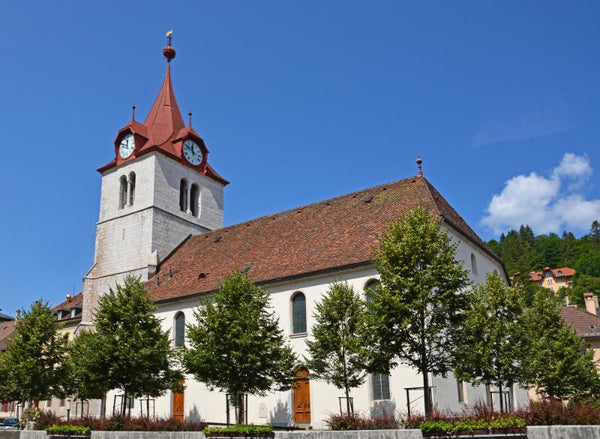
With around 40,000 inhabitants, the town in the western canton of Neuchâtel is one of the largest in the region. It stands out not only for its high elevation of roughly 1000 meters above sea level, but above all for its checkerboard street layout. The streets, laid out at right angles, are lined with Art Nouveau buildings and offer a wealth of cultural attractions: alongside buildings by Le Corbusier and the famous tower clock of the Grand Temple, which long served as the town's official time reference, there are five museums with different specialties. It's no accident that La Chaux-de-Fonds was declared a UNESCO World Heritage Site in 2009 – together with Le Locle, just 8 kilometers away and likewise famous for its watch industry.
Watch enthusiasts will have a clear favorite among these museums: with the International Museum of Horology, the Neuchâtel town is home to one of the most important collections in the field. Set in an idyllic park, it brings the history of timekeeping to life through many rare and astonishing instruments. Naturally, the prestigious brands are on display too, represented by their watchmakers' most exclusive masterpieces. Highlights among the more than 4500 exhibits include several original pieces by Abraham Louis Breguet, a 14th-century astronomical clock, and a marine chronometer by Swiss pioneer Ferdinand Berthoud.
Great Brands, Rich History
First mentioned in records in 1350, La Chaux-de-Fonds grew from a farming village into an industrial community over the course of the 18th century.

The real boom, however, came with the watch industry: groundbreaking innovations from 1800 onward made it possible to produce ever more reliable timepieces – they could now be sold in greater numbers than before and created countless jobs. TAG Heuer and Girard-Perregaux, two of today's most famous manufacturers, took part in this process and are still headquartered in the high-altitude town.
The company founded by Edouard Heuer in 1860 proved especially innovative: with the first patent for a stopwatch mechanism in 1882, the first chronograph accurate to 1/100th of a second in 1916, and the first quartz chronograph with an analog display in 1983, TAG Heuer has contributed enormously to the progress of the watch industry throughout its history.
Yet the brand wasn't founded in La Chaux-de-Fonds at all, but in Saint-Imier, 15 km away. So the town seems not only to produce ingenious watchmakers, but to attract them as well.
Birthplace of Countless Innovations
Another prominent resident manufacturer is Girard-Perregaux: the luxury brand ranks among the most exclusive manufactures in the world and gained renown through achievements such as the exceptionally precise Gyromatic movement of 1957.
If you're looking for intricate and outrageously expensive complications, you've also come to the right place: tourbillons and perpetual calendars are as much a part of Girard-Perregaux's repertoire as exclusive chronographs.

Today the brand, like the Ulysse Nardin manufacture based in neighboring Le Locle, belongs to the Kering group. The fact that their ties to the watch town remain evident despite international corporate links makes both brands as likable as they are credible.
A Magnet for New Manufacturers
In recent decades, however, La Chaux-de-Fonds has also become home to many smaller manufacturers that uphold the town's progressive reputation with ever new and creative timepieces. Take Corum, for example, founded in 1955: the company specializes in the upper price range and offers its customers highly unusual models. After all, which of the bigger brands offers a model whose dial is made from a genuine, legal-tender 20-dollar coin?
In stark contrast to Corum's eccentric collections, Ebel, founded in 1911, takes a decidedly classic approach, as its successful "1911" and "Sport Classique" lines show. Wearing one of Ebel's masterpieces transports you back to the glorious days of the 19th and early 20th centuries, when La Chaux-de-Fonds underwent its unparalleled rise as a watchmaking town.
Vulcain is certainly not one of the best-known makers of luxury watches, but it is one of the most distinctive. Founded as early as 1858, the manufacture has repeatedly shown remarkable ingenuity: in 1947, for example, when it created the first hand-wound wristwatch with an integrated alarm. Or in 1961 with the "Cricket Nautical", the first dive watch with a decompression scale adjustable via the crown.
Nor does Vulcain lack prestige: often called "the President's watch", the brand was worn by U.S. Presidents Truman, Eisenhower, Johnson, and Nixon.
Conclusion: A Center of the Watch Industry with Strong Character
The heart of today's watch industry beats in several places at once: Geneva, Le Locle, and Grenchen, as well as Glashütte, rank among the most important watch towns in the world. Weighing the history and significance of all these places, La Chaux-de-Fonds, with its strong character, stands out in particular:

Cultural, architectural, and industrial diversity define the town – without it, the modern watch world as we know it might never have come into being. It is not only home to renowned brands, but also the birthplace of many smaller manufacturers and groundbreaking ideas – this is what a solid bridge between past and future should look like.