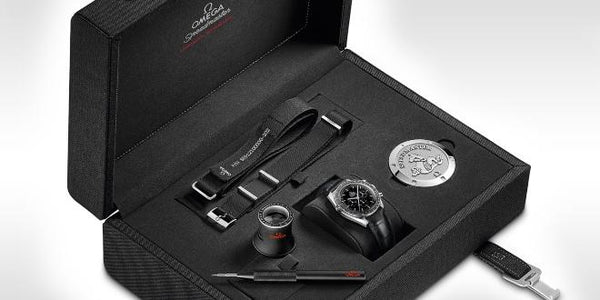
« The Epitome of Sporty Elegance »
For Omega enthusiasts, it's no secret that the range of the Speedmaster extends far beyond the famous Moonwatch Professional. Standing in the shadow of the Apollo moon watch is the Omega Racing: a nod to the collection's original motorsport heritage, it ranks among the most luxurious and historically significant models from Biel. Read on to find out why it deserves more attention, why it costs almost twice as much as a Moonwatch, and what makes the automatic Caliber 9900 special.
Space Was Never the Goal
The origins of the Omega Racing date back to 1957, when the storied Swiss brand – already more than a century old at the time – launched the most celebrated trio in its history: the Seamaster 300 diver (Ref. CK2913), the antimagnetic Railmaster (CK2914), and the Speedmaster sports chronograph (CK2915). Although the latter rose to fame in space from 1962 onward, when US astronaut Walter Schirra wore its successor reference CK2998 on the Mercury-Atlas 8 mission, it was never designed for that purpose.

In fact, long before the era of the Caliber 9900, its engineers conceived it as a racing driver's watch, with a design inspired by the dashboards of 1950s Italian sports cars. That explains not only the "Speed" in its name but also the world's first tachymeter scale on the bezel rather than on the dial. Every detail was optimized for maximum usefulness in a sports car cockpit: arrow-shaped hands for legibility, a black dial for contrast, and integrated lugs for a secure fit on the wrist. Naturally, these features also proved helpful in outer space, but the chronograph only ended up there by chance.

To revive its motorsport DNA, several Omega Racing editions have appeared over the course of the model's history. The first step came in 1968 with a variant of the 145.022-68 featuring a gray dial and an orange chronograph hand, followed by the far more famous MK II "Racing" of 1969. The Schumacher editions unveiled in 1996, a Racing variant designed for the Japanese market in 2004, and subsequent timepieces also kept the memory of the "Speedy's" racing heritage alive. The current collection, known as the Omega Racing Co-Axial Master Chronometer, debuted at Baselworld 2017 and comprises ten models, all of which differ markedly from the Moonwatch. The Caliber 9900 had already premiered at the watch fair a year earlier. It is Omega's first chronograph movement to receive the new METAS certification and, as the successor to the 9300, first ticked inside a Seamaster Planet Ocean in 2016.

A Larger Case and Two Subdials Instead of Three
One of the biggest differences lies in the case size: 44.25 instead of 42 millimeters gives it a strong wrist presence and calls for a wrist circumference of at least 18 centimeters for a comfortable fit. The sporty aesthetic with the curved edge of the lugs remains unchanged, as do the 50 meters of water resistance and the design of the three-link metal bracelets. One millimeter wider than on the Moonwatch, the bracelets can be swapped on request for classic alligator straps with contrast stitching or a perforated leather strap with an orange rubber lining. Because this perforated option has the strongest associations with motorsport, we think it suits the Omega Racing best.
Far more important, however, are the differences on the dial. Covered by a domed sapphire crystal with anti-reflective coating on both sides, it catches the eye with its racing-style minute track with offset five-second intervals and departs from the Moonwatch's classic tri-compax layout. Instead, we find a pared-down design with two subdials: a small seconds in the familiar nine o'clock position and a combined chronograph hour and minute counter at three o'clock. At first glance, you might mistake the latter for a second time zone, but after a short period of getting used to it, it lets you read elapsed intervals effortlessly. The Omega Racing fills the space freed up in the lower center with a date window whose disc fortunately matches the respective dial color, lending it a pleasing restraint. We find the overall effect of the dial interesting: despite doing without a third counter, it doesn't look cleaner but rather livelier and more multifaceted than the Moonwatch's.


Five Dial Colors to Choose From
That observation has a lot to do with the chronograph's range of colors. The dial of the stainless steel models is available in four colorways, with black standing out as the most classic option. Here, buyers can choose whether to add orange accents (hands, indexes, tachymeter lettering) or prefer an all black-and-white look. The shimmering gray editions, by contrast, always feature orange details, while the white models stand out with gray hands and subdial rims. If you want to make your Omega Racing even more exclusive, you can opt for a fourth stainless steel version with a matte gray dial, an 18-karat Sedna gold bezel, and gold hands and markings. At the top of the range sits the only dark blue reference, whose case is made entirely of the majestic precious metal. Overall, we consider the Racing's color variety an important feature because it clearly sets the timepiece apart from the black-and-white Moonwatch and opens up new perspectives on the Speedmaster.

Automatic Co-Axial Caliber 9900 / 9901
Speaking of differentiation: from a technical standpoint, the Omega Racing displays its greatest degree of independence. Rather than adopting the hand-wound, time-tested NASA Caliber 1861 or its newer 1863 variant, it is powered by the automatic 9900 (9901 in the gold model). While the latter can't match the romance of the Moonwatch movements used for decades, it is objectively the better – and above all more modern – engine. That's down not only to the more advanced and complex column-wheel construction but also to the in-house Co-Axial escapement, silicon balance spring, and 15,000 gauss of magnetic resistance. On top of that, unlike the Moonwatch, it carries METAS chronometer certification, which is increasingly becoming the standard as it spreads across the Omega catalog. So if you're wondering about the noticeable price premium of the Omega Racing over its famous sister collection, just look through the sapphire caseback and you'll find the answer.

Which brings us to the topic of price: the manufacturer's prices for the racing chronograph range from €8,090 for the stainless steel versions on a leather strap (€8,380 on a metal bracelet) and €11,210 for the gray edition with a gold bezel up to €25,640 for the solid gold Master Chronometer with a blue dial. If you want to combine top-tier technical performance with sporty elegance and one of the richest histories in modern horology, you should definitely consider the Omega Racing for your next watch purchase. And of course, keep an eye on the Caliber 9900.