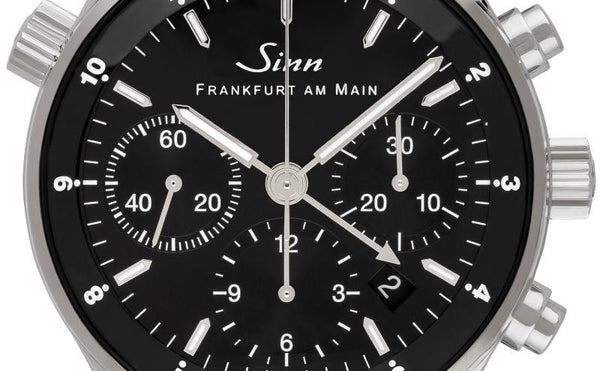
Rugged instrument watches with smart technologies: since its founding in 1961, Sinn has stood for dependable functionality on the wrist like few other brands. That the down-to-earth Frankfurt watchmaker can also do exclusive is proven by two new limited editions of the well-established 756 Duochronograph. While distinctive details set them apart from the regular collection, the use of innovative solutions remains at the brand's usual high level.
Gray Elegance or Blue Contrasts?
We're talking about the Sinn 756 II and III editions, each limited to 75 pieces. Technically one hundred percent identical, these rare Duochronographs differ mainly in their dial design. Two completely different characters emerge here, with the 756 II aiming to win you over as the understated gentleman. It isn't flashy, but all the more elegant for it. Its warm gray color scheme radiates a pleasant calm, further enhanced by the Duochronograph's ivory-colored totalizers.


A subtle yet effective contrast that boosts the already phenomenal legibility. The latter is the result of more than generous markings: broad Arabic numerals at 3, 6, 9, and 12 o'clock are matched by equally bold minute track markers. The date display at 4 o'clock looks almost dainty by comparison – a larger version could easily have been chosen here. All the more successful are the dark red accents on all the hands, which lend the otherwise rather reserved Duochronograph an appealing touch. Nevertheless, the II remains a deliberately refined companion, in clear contrast to the expressiveness of the dark blue 756 III.
Bright Orange for a Strong Presence
Quite unlike its refined Duochronograph sister model, the III aims to stand out from the crowd with strong color contrasts – and succeeds brilliantly. Not only the outer markings but also the seconds and chronograph hands come in dynamic orange, which pairs surprisingly well with the deep blue background. This ensures that the white hands and indices create noticeably higher contrast than on its gray sibling – making them even easier to read. All other features, however, such as the dial structure or the small date display, are identical on both Duochronographs. The same goes for the excellent proportions of the case.


A 40-millimeter diameter suits slim and broader wrists alike, while classic curves ensure a timeless look. One of the key differences between the 756 II and 756 III Duochronographs lies in the finish of their cases: the former relies on fine matte, bead-blasted stainless steel that perfectly underscores the chronograph's noble appearance. Its dark blue counterpart is quite different, with polished and satin-finished metal emphasizing its bold presence.
What unites both Duochronographs is the use of the Frankfurt brand's TEGIMENT technology: this surface hardening is not a coating but a targeted strengthening of the stainless steel itself. The result is exceptional scratch resistance and durability.
Top-Class Technical Know-How
Yet TEGIMENT is only a small foretaste of the many ingenious technologies in the Sinn 756. What starts with simple water resistance to 200 meters continues with extreme magnetic field protection up to 80,000 amperes per meter. Indicated by a small symbol to the right of the 9 o'clock position, it uses a special protective shield to minimize the negative effects of magnetic fields on the movement's precision. The delicate hairspring in particular can be severely disrupted by strong magnetism.
Another highlight of both Duochronographs is the so-called Ar-Dehumidifying Technology. It effectively shields the mechanism from penetrating moisture, preventing the oils from aging and increasing functional reliability.
A pleasant side effect: Sinn grants a three-year warranty on every timepiece with this technology. The features of the Duochronograph models are rounded off by sapphire crystal with anti-reflective coating on both sides, high temperature resistance from -45°C to +80°C, and a screw-down crown.
Proven and Reliable: The Valjoux 7750 Caliber
Given the extensive feature set of the limited Duochronographs, the question of price inevitably arises. Anyone expecting a fortune because of the small production run or sophisticated technologies will be pleasantly surprised: Sinn asks €2,380 for the 756 II on a stainless steel bracelet, while the 756 III on the same bracelet costs €2,670. Fair prices, especially compared with the price tags of similarly functional Swiss instruments. You can save a little with the leather straps, which we recommend primarily for aesthetic reasons: the respective gray or black versions with orange contrast stitching perfectly match the rest of the design of each special edition. The harmonious aesthetics are matched by solid technology inside.
The Sinn 756 Limited Editions are powered by the automatic Valjoux 7750, with a power reserve of around 44 hours. Beating at a frequency of 28,800 vibrations per hour, it has already proven its reliability in dozens of other chronographs and should give the 756 Duochronographs a long and trouble-free life.
The Next Level: Sinn 756 DIAPAL
As you might already suspect, the two Duochronograph special editions are not the only members of the 756 family. If you can do without the strict limitation, the somewhat more modern 756 DIAPAL rewards you with an even broader range of features. Specifically, all the features of the limited editions are supplemented by a GMT function and Sinn's DIAPAL technology.

The latter refers to a lubricant-free lever escapement in which special material pairings ensure lasting accuracy. Essentially an upgrade of the Ar-Dehumidifying Technology, it comes with a full five-year warranty instead of three. Price according to the manufacturer: around €3,000. Attractive terms that will probably soon be the only way to get a 756 – once the 150 limited models have found their happy owners.