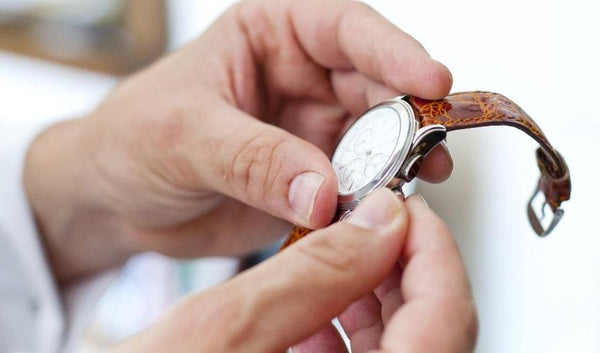
If you favor mechanical masterpieces, you know that today's accuracy and precision are impressive, yet they have their limits. A certain amount of deviation is part of the commitment to fine craftsmanship, but large discrepancies are a signal – of mistakes in how the watch is worn, of a long-awaited service, or that it's time for a timepiece that better suits your lifestyle.
Vision Versus Reality in Mechanical Masterpieces
Ideally, a wristwatch would always display the exact reference time, which in Germany is set by the Physikalisch-Technische Bundesanstalt with its atomic clocks. No manufacture has reached that ideal yet. A mechanical movement consists of an impressive number of components, all meticulously matched to one another.
Despite the passion for perfection, small irregularities are unavoidable. This is especially true over the long term, since even the finest materials cannot rule out wear or contamination. On top of that come external influences that cause timekeeping errors. Although ambitious heritage brands invest a great deal of passion and know-how in reducing rate deviation, the fact remains: if you love mechanical timepieces, you need to bring a little tolerance.

Benchmarks – Excellent, Good, and Acceptable Deviation per Day
Newcomers are usually thrilled the moment their first mechanical self-winding luxury watch sits on their wrist. It seems like a small miracle that the hands make their rounds flawlessly without any external power source while you proudly admire the superb design. In the age of radio-controlled watches and smartwatches, however, one detail takes some getting used to: the time display is almost never exact. Which leads to the question:
Is the Deviation of My Automatic Watch Normal?
If the daily irregularities fall between -4 and +6 seconds per day, the Contrôle Officiel Suisse des Chronomètres issues its certificate. The name of the renowned institute says it all: the result is excellent. After all, portable timepieces may only be marketed as chronometers if they are exceptionally precise.
Ambitious watch manufactures voluntarily raise the quality standards for their masterful collections. Omega, for example, opts for METAS certification, which defines 0 to +5 seconds as the acceptable deviation per day. You can be entirely satisfied if the average deviation is within +/- 10 seconds. Since 86,400 seconds pass each day, the display is then 99.9 percent accurate. As a general rule, there is no cause for concern for the time being as long as a mechanical movement runs no more than half a minute fast or slow per day.


Rate Deviations – Usually Normal, Sometimes Alarming
By chance, you meet a kindred spirit who has treated himself to the same masterpiece. While chatting, however, you notice a difference: he raves that he detects no deviation at all, whereas your own watch uses up the full specified precision range. There is no reason to worry at this point. Your new acquaintance is simply lucky, and the accuracy of your own model is still impressive. It is typical of fine craftsmanship that minimal differences arise during manufacturing even when every production step is carried out meticulously.
It is equally normal for a mechanical movement to run somewhat unevenly at first. These "teething troubles" can be caused, for example, by the lubricant not yet having reached all the components inside. If the problem doesn't resolve itself, the movement may need to be regulated. This is a simple, routine procedure that should always be carried out by the manufacturer or an authorized watchmaker, because having an exclusive automatic watch opened by unauthorized persons can void the warranty.
Inaccuracies within the certified tolerance range are fine. The same applies if the deviation of your daily companion increases slightly over the years. You should pay attention if a mechanical wristwatch suddenly and significantly departs from its usual accuracy. Exact today, slow tomorrow, fast the day after: you should also keep an eye on large fluctuations. If the rate doesn't stabilize again, a check-up by an expert is recommended.

Want Better Accuracy? A Little Care Goes a Long Way!
Watch manufactures take every factor affecting accuracy into account to counteract deviations as effectively as possible. Once a masterpiece leaves the workshop, however, the owner's involvement is required. How the watch is worn and stored affects its rate deviation as much as its overall condition. With self-winding, constant wear generally keeps the energy supply topped up. Even so, some experts recommend fully winding the watch by hand at regular intervals. If a timepiece is left lying for a longer period, it stops, which the automatic movement doesn't like. That's why specialist retailers such as Uhrinstinkt offer watch winders for valuable collector's pieces.

Automatic watches often run faster in high temperatures and slower in the cold. Watch collections should therefore be kept in a stable indoor climate. Only expose a favorite piece to extreme temperatures if it was explicitly designed for them. The same applies to severe vibrations, impacts, or moisture.
Practical Detox Treatments and Timely Servicing
Magnetic fields are among the major factors affecting accuracy. Today, however, they are everywhere, emanating from laptops, smartphones, induction cooktops, or bag clasps, for example. If you notice a rate deviation, it may be time for demagnetization – at a specialist retailer or with your own device. The problem is significantly reduced with modern luxury watches designed to be antimagnetic. This feature is indispensable if magnetic influences are a defining part of your job or leisure activities.

Even the best components wear out. Oils can become gummy. Fine dust manages to sneak through even the tightest case. In short: if you want to enjoy a fully functioning automatic watch for years to come, you should stick to the service intervals recommended by the manufacturer.
Quartz vs. Automatic Watch – Why Not Both?
There are many professional or personal reasons to place great importance on minimal rate deviation. It's just as understandable if you'd rather not constantly deal with influencing factors and watch care. If that sounds like you, a quartz watch may be worth considering for everyday wear. Good models deviate by about 60 seconds per year, while the battery lasts up to three years.
The Classics Quartz collection from Frédérique Constant pairs as well with a business suit as with casual wear. With its clear time display, date window, and cosmopolitan GMT function, it meets all common needs at the same time. The icing on the cake: the brand doesn't ask for a large investment, leaving more budget for your mechanical labor of love.


Will your watch experience more adventures than elegant moments? Then this tip is valuable: COSC certification attests to excellent accuracy under normal conditions. Extreme weather, movement, impacts, or magnetic fields: experienced manufactures take into account in their own tests that expedition watches or sports chronographs, for example, are exposed to greater stresses.


This ensures that accuracy remains convincing and functionality is preserved despite special influences. That's why it pays to focus on collections designed for your intended use that meet all your personal quality standards.