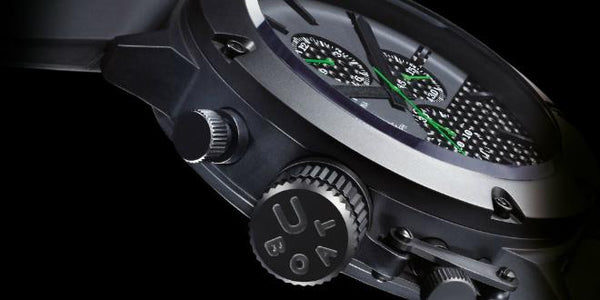
Chronographs are especially popular today among men's watches. Yet the key technical foundations for this type of watch were developed more than a century and a half ago. Every model therefore offers its wearer not only an additional stopwatch function but also embodies a fascinating piece of watchmaking history.
A Child with Many Fathers
It is fascinating if only because it remains disputed who actually invented the chronograph. Anyone who looks more closely at this chapter of horological history quickly realizes that it is most likely a child with many fathers. Numerous technical innovations were needed before watchmakers were able to build a "true" chronograph. It differs from other watches through its stop function, but it is not simply a stopwatch, because the movement is not halted during timing. This makes it possible to measure specific intervals while the display of the current time continues to run unaffected.

It is this ability to record specific intervals that gave the timepiece its name. The word is composed of the Greek words chronos and grapho, meaning "time" and "I write." Adolphe Nicole is often named as the inventor; in 1844 he developed the so-called heart cam for resetting to zero and filed a patent for this invention. However, as early as 1720 the Englishman George Graham had already found a technical solution that allowed intervals to be estimated with an accuracy of about one-sixteenth of a second. He can therefore rightly be counted among the inventors of the chronograph as well.
Meanwhile, the first pocket watch with a chronograph function was presented to the public in 1862 by the Frenchman Henri Féréol Piguet. Around 60 years earlier there had already been pocket watches whose seconds hand could be stopped, but on these models stopping the hand still brought the entire movement to a halt. If you wanted to time intermediate intervals with such a watch, you had to add the stopped time back on each time.
"False" and "True" Chronographs
Today, however, even Piguet's pocket watch with a stoppable seconds hand is referred to as a "false chronograph." The credit for creating the first "true" chronograph goes instead to the Parisian watchmaker Nicolas-Mathieu Rieussec, although his design initially had relatively little in common with today's wrist chronographs.
Rather, his model was a watch that was capable of literally "writing down" measured times. For this purpose, he installed a small pen on the dial that recorded the measured intervals with small and large marks as the hands rotated. Rieussec patented his invention in 1822.

Another important step followed in 1831, when Joseph Thaddäus Winnerl developed a watch whose seconds hand could be stopped separately. Winnerl, an Austrian-born employee of the Breguet manufacture, also invented a chronograph variant in which two superimposed seconds hands could be stopped one after the other, so that the measured interval could be determined as the difference between them. Technically, this requires two separate but coupled stop mechanisms. Such a double-hand mechanism can still be found today in various high-end mechanical watches and is known as a rattrapante, split-seconds, or split-seconds hand.
This look back at watchmaking history shows that it was a long road to today's quartz and automatic models, and that a number of inventions made this development possible.
Timepieces for the Wrist
Once the heart cam had provided a way to return the seconds hand to zero at the push of a button, chronographs already had an essential functional feature that remains typical of them to this day. In 1868, Auguste Baud began building the additional mechanism for a chronograph hand—still common today—as a module on the dial side of the movement.
A few decades later, wrist-worn chronographs finally took on, thanks to a development at Breitling, the characteristic look that most of them still have today: a wristwatch with two separate pushers. One pusher is used to start and stop, while the other is used to reset the chronograph hand to zero.
Modern Developments with Automatic or Quartz Movements
A modern mechanical wrist chronograph is usually an automatic model, and there are also numerous quartz watches with a chronograph function. Initially—in parallel with developments in watches without a stop mechanism—watchmakers searched for ways to equip chronographs with automatic winding as well. As early as 1946, Albert Piguet had developed a corresponding prototype together with Lémania. However, more than twenty years would pass before the first automatic chronograph was ready for series production.
In 1969, three manufacturers engaged in a tight race to be the first to present a series-produced automatic model. In the end, Zenith with its "El Primero" movement narrowly prevailed over Seiko with its caliber 6138/39 and over a joint venture of Heuer, Breitling, Dubois-Dépraz, and Büren. With the rise of quartz watches in the 1970s, however, automatic timepieces were nearly pushed out of the market again. After all, a quartz model is not only much cheaper to produce but also offers considerably more extensive functionality than an automatic. Yet as part of the general renaissance of high-quality mechanical watches, automatic chronographs have once again enjoyed great popularity since the mid-1980s and are valued far more highly by connoisseurs of fine watches than quartz watches with a stop function.


It is therefore hardly surprising that nearly all major watch manufactures regularly launch new chronograph collections. These are often wristwatches with a distinctly sporty design, but there are also numerous masterpieces whose style corresponds to that of a classic dress watch.
A Selection of Current Chronograph Watches
A typical example of a modern, sporty automatic chronograph is the Breitling Avenger Bandit, with a rugged titanium case, aviation-style stencil numerals, and a strap made of high-tech military textile and rubber.
If you are looking for a high-quality quartz chronograph, you might opt for the Tag Heuer Formula 1 Quartz or the Tag Heuer Aquaracer 300M Quartz.
And if it should be a particularly luxurious version, the Rolex Cosmograph Daytona in one of the new gold versions is certainly a strong favorite.