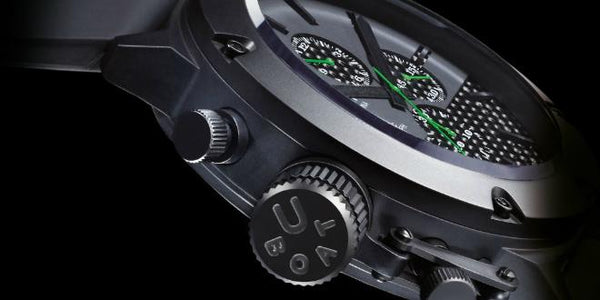
The chronograph, also known as a stopwatch, is one of the most significant developments in the history of watchmaking. It looks back on a fascinating history spanning several centuries. The development and function of the chronograph are closely tied to the evolution of mechanical watches, since it is based on the same mechanisms. From early rattrapante watches and the first flyback mechanism to automatic chronographs and beyond, its history has produced a number of iconic models.
The Beginning: The First Chronographs in the 18th Century
The origins of the chronograph date back to the 18th century, when watchmakers began adding extra complications to conventional timepieces. As early as 1776, a key development came from the Geneva watchmaker Jean Moïse Pouzait, who designed an independently driven seconds hand. The seconds hands of this design had their own barrel. Although this seconds hand could be stopped, it could not be reset to zero. Moreover, stopping the watch brought the entire movement to a halt. When it came to timing intervals, the period during which the watch had been stopped first had to be added back in order to determine the time of day.

Milestones in the 19th Century
Over the course of the 19th century, various improvements and innovations were made to the chronograph. An important milestone came in 1831 from the Austrian watchmaker and Breguet collaborator Joseph Thaddäus Winnerl. He is credited with the double-hand or rattrapante mechanism. Its operating principle is based on two seconds hands mounted one above the other. These can be stopped one after the other, and the time interval being measured is calculated as the difference between them. To do this, the watch requires two independent yet coupled stop mechanisms. Because of this principle, the rattrapante chronograph is also known as a split-seconds chronograph. Another name for the rattrapante is the split-seconds hand.

Another major advance was the invention of the chronograph with zero reset by Adolphe Nicole. In 1844, he invented the so-called heart cam, for which he filed a patent in 1862. That same year, it was presented in the form of a fully functional pocket stopwatch. The heart cam can be seen as the forerunner of the flyback chronograph. This chronograph made it possible to reset the hand immediately after stopping, without having to stop it first. This function was especially important for pilots and military personnel.
The Golden Age in the 20th Century
In the 20th century, the chronograph enjoyed a true golden age. In the 1930s, Breitling introduced the first chronograph with a second pusher, which allowed the start, stop, and reset functions to be operated independently of one another. This flyback technology is still used in most of these watches today.

In the 1960s, the chronograph conquered the world of motorsport. The famous Swiss watchmaker Heuer (today TAG Heuer) developed the legendary Autavia, a racing chronograph designed specifically for race car drivers. This watch featured a tachymeter scale for measuring speed. With their signature design of two to three totalizers (subdials), the various Autavia models became a symbol of motor racing.

Automatic Chronographs
A major breakthrough was the development of the first automatic chronograph. It no longer had to be wound by hand; a rotor took over the job while the watch was worn. The caliber 6139 was developed by the Japanese watch manufacture Seiko in the late 1960s and launched in 1969.
It was the first integrated chronograph movement with automatic winding. It made its debut in the Seiko Speedtimer, which reached the market shortly ahead of its Swiss competitors (Breitling, Heuer, and Zenith).

Quartz and Digital Models
In recent decades, watches of every caliber have increasingly been equipped with modern technology. The introduction of quartz watches in the 1970s made it possible to measure time intervals precisely to the hundredth of a second. Later, stopwatches with electronic displays and digital readouts were developed to allow even more precise measurements.


Today, chronographs are available in many different versions, from classic mechanical models to high-tech watches and smartwatches. The latter are more precise and can measure the smallest intervals. Yet time-honored mechanical chronograph types in particular remain highly popular as exquisite pieces of jewelry. Subdials as an aesthetic feature define the look of many iconic chronograph models. Faithful versions with a rattrapante mechanism can also be found, especially in the luxury segment.


How It Works: The Mechanics of Timekeeping
At its core, a chronograph is a watch with additional functions that allow time intervals to be measured. The chronograph’s operating principle relies on a complex interplay of various mechanisms. These can differ depending on the type of watch (for example, hand-wound, automatic, or quartz chronograph), but what they all share is the ability to measure time intervals. A chronograph should not be confused with a chronometer. The latter simply refers to a particularly accurate mechanical watch. A chronometer’s accuracy is usually confirmed by a certificate (from COSC for Swiss movements). Of course, there are also chronograph calibers whose accuracy meets chronometer standards.


How the chronograph function works:
- On the one hand, the chronograph has a movement that displays the normal time. This movement drives the hour, minute, and seconds hands and ensures the time is displayed correctly.
- In addition, the chronograph has an extra hand: the chronograph seconds hand. It is often positioned in the center of the dial. This hand can be started, stopped, and reset using a pusher, which is usually located on the side of the case near the crown.
- A key component of this type of movement is the coupling system. It consists of a clutch that connects or disconnects the additional chronograph seconds hand from the movement. When the chronograph is not running, the clutch is disengaged, so the chronograph seconds hand does not move and serves no function.
- As soon as the start/stop pusher is pressed, the clutch engages and connects the chronograph seconds hand to the movement. The hand now begins to run and measures the elapsed time. A chronograph usually has subdials or totalizers to display, for example, the minutes or hours measured.
- To stop the timing, the pusher is pressed again. The clutch disconnects the chronograph hand from the movement, while the minute and hour hands continue to show the normal time. To reset the chronograph hand, a separate pusher is pressed. This returns the chronograph seconds hand and, if present, the minute and hour hands of the totalizers to zero.
- This basic operating principle applies to mechanical stopwatches. However, there are various versions and types of chronographs, including quartz models and modern digital watches based on electronic technology. The fundamental purpose of measuring time intervals remains the same.