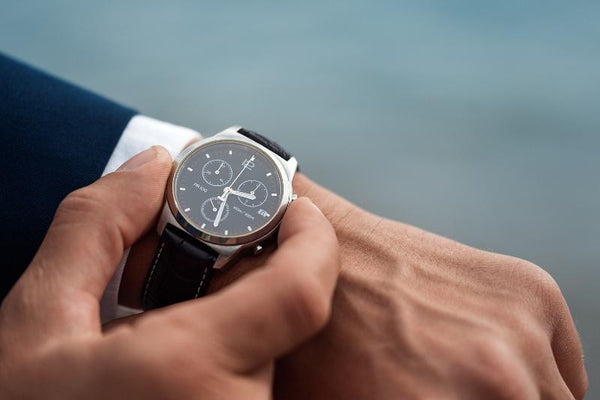
« Experts explain how to spot counterfeits »
The more valuable and sought-after something is, the greater the incentive for criminals to bring counterfeits of it to market. That applies to banknotes just as much as to gemstones, precious-metal jewelry, works of art or designer fashion – and, of course, to luxury watches. We have put together a few expert tips for our readers that can help them tell fake watches from genuine ones.
Counterfeit luxury watches – an old and global problem
Even Abraham-Louis Breguet (1747-1823), who thanks to his skill, inventiveness and business acumen became one of the most successful watchmakers in history, had to contend with a nagging problem: the greater his success and the higher the prices paid for his watches, the more often counterfeit versions of them turned up on the market.
To at least make the counterfeiters' work harder, if it couldn't be stopped entirely, the old master Breguet gave his watches a kind of secret signature. If someone wanted to have a supposed Breguet watch authenticated, he could tell them beyond doubt whether or not it had really come from his workshops.


Not much has changed since then. Year after year, counterfeiters continue to inflict considerable economic damage on luxury watch manufacturers. According to the Federation of the Swiss Watch Industry FH, there are now more counterfeits and replica luxury watches than genuine products.


Swiss watchmakers produce a total of around 30 million watches a year, yet at the same time several tens of millions of counterfeit watches are offered for sale every year through a variety of channels. Particularly popular models from internationally renowned brands such as Rolex or Omega are counterfeited disproportionately often, but in principle almost every major brand is affected.
Replica and counterfeit luxury watches are often hard to spot
Of course, anyone should realize that a quartz watch bearing the name "Rolex" and bought for a few euros is almost certainly a fake. In many cases, though, telling counterfeits from originals is far from easy, especially when they are offered for sale online and the buyer can't examine them closely beforehand.
The Federation of the Swiss Watch Industry has set up a dedicated unit that specializes in tracking down online listings of counterfeit luxury watches, having them taken down and arranging for the fakes to be destroyed.
But the counterfeiters, for their part, are becoming ever more professional. On the one hand, outright replica luxury watches that are fakes from top to bottom are now often made with such attention to detail that even connoisseurs struggle to identify them as counterfeits. On the other hand, there is a growing market for so-called Frankenwatches, which are assembled from genuine parts of Swiss origin, but taken from different watches or models and never put together in that combination by the manufacturer itself. Telling such a watch apart from a genuine vintage model takes comprehensive expertise and detailed knowledge of historical models.
Buying from an authorized dealer: the safest route
Probably the safest way to avoid being taken in by counterfeiters is to buy from a brand boutique or an established authorized dealer. Many major watch manufacturers list on their websites where they operate their own boutiques or which watchmakers and jewelers serve as their authorized dealers.

If you buy only there, you can be sure of receiving genuine original goods with an authentic manufacturer's certificate. An authorized dealer is also the right point of contact if you want to have a pre-owned or inherited watch authenticated – they can open the watch properly if needed and take a close look at the movement.
Tips for watch connoisseurs – and anyone who wants to become one
If you aspire to acquire the expertise needed to identify counterfeit luxury watches yourself, you'll above all need plenty of time, background knowledge and experience. The same naturally applies to anyone who likes to hunt for interesting offers at flea markets, collectors' fairs or, indeed, online.

Thorough knowledge of brand and model history is probably the most important foundation for spotting suspicious or mismatched features on a watch and interpreting them correctly. After all, an accompanying certificate can be just as fake as the "luxury watch" itself, so it only offers extra security if it was issued directly at the time of purchase by an authorized retailer.


Looking closely and critically enough yourself or having the watch authenticated by an expert are therefore the only two options. As a rule, the risk of falling for a fake is considerably higher with an Omega Moonwatch or a Rolex Submariner than with lesser-known models and brands that are also in less demand on the secondary market.
Having a watch authenticated: a thorough function test is as simple as it is effective
As obvious as it may sound, in practice a thorough function test often proves a reliable way to expose particularly brazen fakes. If a watch features complications such as a second time zone or a chronograph, be sure to test them before buying.

If it turns out that only core functions such as the time display or date work, but other functions don't, this can be an important sign of a fake, even if everything looks right on the outside. When it comes to having a watch authenticated, the manufacturers themselves are also happy to help by answering inquiries about specific models and their features.
In individual cases, it can also make sense to send the watch in question, well and securely packaged, to the manufacturer to have it authenticated directly on site.