« No Chance for Fakes of Rolex, Breitling and Co. »
Fakes, counterfeits and Franken watches are a phenomenon that has long since spread beyond the best-known brands. Alongside the typical fake Rolex or Breitling, counterfeit watches turn up in almost every price segment. According to the Federation of the Swiss Watch Industry (FH), there are now more counterfeits in circulation than genuine watches. Fakes are becoming more professional and increasingly difficult to tell apart from the real luxury watch. Still, there are indicators that, when carefully considered, reliably protect you from counterfeits.
Overview and Distinctions: Types of Fakes in the Watch World
There are various types of counterfeit watches available on this hard-to-navigate market. Knowing these common types helps enthusiasts identify how fake women's or men's watches differ from the original.
Imitation
Imitations are among the most common types. They look very similar to the original watches but are made from inferior materials and often show flaws in finish, weight and details. They are frequently sold as cheaper alternatives to the originals. Some counterfeiters illegally advertise such men's or women's watches as genuine.

Replica
Closely related to imitations are replicas. Replicas are watches that match the originals very closely in design, materials and finish. They are designed to be deceptively similar to the genuine model in quality as well. They often bear quality markings such as "Swiss Made" and are hard to distinguish from the originals. Replicas are therefore usually considerably more expensive than simple imitations. Replicas are especially popular for historical or discontinued models, since collectors pay exorbitant prices for them.

Homage
The homage is not a direct fake. Homages are watches that copy the design of well-known luxury watch brands but are sold under their own brand name. They aim to imitate the style and look of the original watches without being considered outright counterfeits. However, the quality and the movement may differ from the models they are based on.
A Special Case: Franken Watches
So-called Franken watches occupy a special position. The name derives from Mary Shelley's Frankenstein. Just as the famous creature from the Gothic novel was assembled from all sorts of body parts, a Franken watch consists of a wide variety of components. Some of these may be genuine, while others may be inferior parts of unknown origin. This type of timepiece is therefore not a pure fake but holds a special status, coming more or less close to the original depending on how it was put together.

Franken watches may, for example, combine a genuine case with a fake movement, or vice versa. Popular models such as the Rolex Submariner are often fitted with generic movements instead of the expensive in-house caliber. Precise identification may therefore require a trained eye looking inside the movement.

Frequency and Brands
It is difficult to provide exact figures on how often counterfeits of specific manufacturers' watches occur. Well-known, prestigious brands are attractive targets for counterfeiters, so fake Rolex, Breitling or TAG Heuer watches are common. But fake Mido or Hamilton watches are flooding the market as well. Brands serving mid-range price segments are also affected. Swiss manufacturers such as Oris, Fortis or Certina can be targeted by counterfeiters just as much as Japanese luxury watches from Seiko. Fakes affect women's and men's watches alike.
It should be noted that the availability and prevalence of counterfeit watches can vary greatly from region to region. In some countries and markets where trademark enforcement is less strict, more fakes may be in circulation. In other regions with stricter laws and monitoring, counterfeits may be less common.

Identifying a Fake: The Key Signs
Spotting counterfeits can be a challenge, since fakes are often cleverly made. Nevertheless, there are a number of signs you can look for to identify them.
Significant Price Discrepancy
Especially with pre-owned watches, it is often possible to save some money compared to the manufacturer's suggested retail price. But if the price seems too good to be true, caution is called for. If the price of the watch you want is well below the usual market value, this may indicate an imitation, a replica or other irregularities. High-quality luxury watches normally carry high prices that are not owed to brand prestige alone. Elaborate mechanical chronograph calibers, tourbillons and other feats of craftsmanship are costly to produce in the first place.

Quality of Workmanship
Genuine luxury watches are made with great care and display high-quality workmanship. Counterfeit models may show flaws in finishing, some of which are visible to the naked eye. In other cases, they require a closer look. The most important and most common workmanship flaws on a fake include sloppy engravings, sharp edges, poorly fitted dials and incorrect fonts on the dial.
Materials Used
Fine watches are often made from high-quality materials such as stainless steel, gold or platinum. Crystals are frequently made of sapphire. A fake may use inferior materials that are easier to spot. You should therefore always check a supposedly genuine watch for the quality of its materials, paying particular attention to signs of rust, wear or color differences.

Inner Workings and Movement
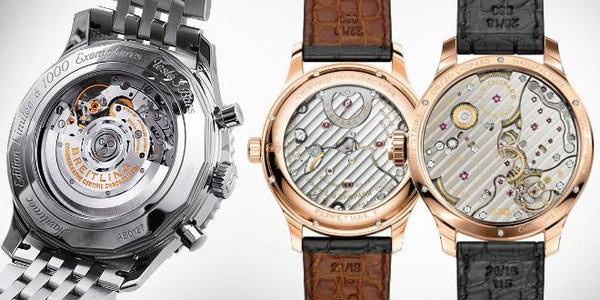
The movement is the heart of a watch and, in high-end models, of high quality. Counterfeit watches may contain inferior movements or even quartz movements instead of the expected mechanical ones. It can be difficult to check the movement without opening the case. Some models have a sapphire display caseback, others do not. When in doubt, it is advisable to have a qualified watchmaker open the watch. In doing so, they can take a look at the inner workings and recognize signs of inferior calibers.
Box, Papers and Reference Number
In most cases, luxury watches come as a coherent package consisting of a high-quality watch box, certificates and the watch itself. If the watch has a Swiss chronometer caliber, for example, it always comes with a COSC (Contrôle officiel suisse des chronomètres) certificate.
Many luxury watches come with an individual serial number or reference number engraved on the case or printed on the certificate. The serial number should be checked for authenticity, and you should make sure it matches the manufacturer's original records. Certificates of authenticity often include security features such as holograms or watermarks.

Keep in mind that these indicators are not always conclusive. If questions about a watch's authenticity remain, it is advisable to consult authorized dealers or experts who can help with a definitive identification.
Buy Your Watch Safely at Uhrinstinkt
Guaranteed authenticity with all papers is what you get at the Uhrinstinkt luxury watch online shop. Reliable originals at a fair price, bought with peace of mind, await you here.