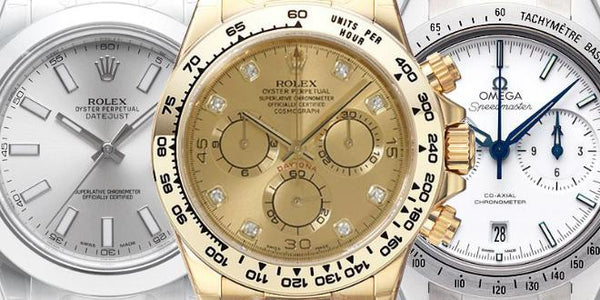
« Metals and Their Use in Luxury Watchmaking »
Cases and bracelets for luxury watches are often made from particularly high-grade materials. Stainless steel is now considered the minimum standard and is used not only for luxury watches but in virtually every other price segment as well. Beyond that, however, there are also numerous watches whose cases, and in some cases bracelets, are crafted from precious metals such as platinum or gold. Here is an overview of the various materials and what sets each of them apart.
Watch Case Materials – A Brief Look at History
A watch case serves an important purpose: it protects the delicate mechanism inside from harmful environmental influences such as dust and moisture. For stationary timepieces such as table or wall clocks, the case has traditionally been made mostly of wood, steel (sheet), chrome-plated brass, gilded bronze, plastic or glass. When choosing the material for the case of a wristwatch or pocket watch, shock resistance is a particularly important consideration. That is why stainless steel, titanium, precious metals and, in some cases, plastics are the materials mainly used today.
 Pocket watches made in the 18th and 19th centuries were generally fitted with cases made of silver or gold alloys. As demand for wristwatches grew in the early decades of the 20th century and they were increasingly produced on an industrial scale, "new" materials such as stainless steel and aluminum came into use for their cases. In the luxury segment, however, cases made of various gold alloys and platinum were, and still are, the norm.
Once the necessary technology was in place, titanium also steadily gained importance as a watch case material from the mid-20th century onward. In addition, watch cases made of ceramic and various plastics came onto the market, although the latter, with a few exceptions, are found not in the luxury segment but rather in affordable fashion and children's watches, and to some extent in sports and casual watches.
Stainless Steel Watches – Today's Most Common Case Option
Most wristwatch cases today are made of stainless steel; genuine gold watches have become relatively rare. Strictly speaking, the German metallurgical term "Edelstahl" refers only to steels with a particularly high degree of purity, regardless of whether they are rust-resistant. In everyday usage, however, it is generally used as a synonym for stainless steel. These are steel grades distinguished by their resistance to corrosion and acids. Corresponding patents were filed in Germany and in the English-speaking world in 1912 and 1913, respectively, and each was granted six years later. As early as 1908, the Germaniawerft shipyard had built a yacht for Krupp using stainless steel, but it took some time before the new material could be produced cost-effectively on an industrial scale.
 Thanks to their material properties, stainless steel watches are not only resistant to shocks and other mechanical stresses, but their surfaces are also not attacked or discolored by perspiration. For this reason, it is often not just the case but the entire bracelet, including the clasp, that is made of stainless steel.
Stainless steel watches with bracelets of the same material are especially common in sporty model lines. Instead of the material's original silvery metallic tone, stainless steel surfaces occasionally display other colors, achieved through appropriate coatings.
Stainless steel watches can, for example, have black, gold-colored or copper-colored surfaces and look just like real gold watches.
Gold Watches – Luxury Watches at the Very Top
For many watch enthusiasts, gold watches are the very epitome of luxury watches. That holds true, at any rate, when the case does not merely have a golden hue but is actually made of a solid gold alloy. As far back as antiquity, gold was prized as much for its aesthetic appeal as for its durability. On material value alone, genuine gold watches sit at the top of the price range at every watch manufacture. Men's watches with relatively slim gold cases and moderate dimensions are particularly popular as dress watches worn with elegant business attire or evening wear, usually paired with straps made of fine calfskin or exotic leathers.
 In addition, many collections from renowned watchmakers include gold watches available with either leather straps or gold bracelets. Classic gold watches are usually made of yellow gold, but rose gold and white gold have since gained a considerable following among watch buyers as well. Because of its mechanical properties, gold is never used in pure form for watch cases, jewelry and similar purposes, but always as an alloy. Depending on which other components the alloy contains alongside gold, and in what proportions, certain properties of the alloy such as hardness or color can be varied.
Traditionally, gold was alloyed with silver and copper: a higher copper content produces a warmer yellow tone, all the way to a rose hue, while a higher silver content results in a cooler, paler yellow.
Today, however, there is also a range of gold alloys to which further metals such as cadmium, gallium, iridium, nickel, platinum, tin or zinc are added in order to achieve certain specific material properties.
Platinum Watches – Exclusive Rarities in the Luxury Segment
Platinum and gold are the most valuable precious metals. While the price of gold is currently higher, there have been periods in the past when platinum held the top spot among precious metal prices for extended stretches. Since the metal, like gold, would be too soft in its pure form, it is used as an alloy.
 Properties such as corrosion resistance, malleability, tarnish resistance and high durability make it a sought-after and, moreover, rare material for the watch and jewelry industry. The alloys mainly used contain 96 percent platinum and four percent palladium or copper. The copper-containing variant is therefore often referred to as jeweler's platinum. Visually, platinum watches differ only slightly from stainless steel or white gold watches, although the whitish-gray tone of platinum alloys can sometimes look a little different. In some cases, such as certain Rolex Yacht-Master or Yacht-Master II models, platinum elements are combined with stainless steel cases.
Because of the high cost of the material, solid platinum watches, like gold watches, are found exclusively in the top tier of the luxury watch market.
 Some platinum watch models are veritable pieces of jewelry, featuring precious and decorative touches such as a diamond-set bezel or gemstone hour markers on the dial, as with some top models of the Rolex Day-Date or Day-Date 40. Without such details, however, platinum watches are particularly well suited to buyers who want to own an especially valuable watch – and perhaps see it as a kind of investment – while still valuing a certain understatement. After all, thanks to its color, it is not immediately obvious what a precious instrument the wearer has on their wrist, since it could just as easily be an ordinary stainless steel watch.