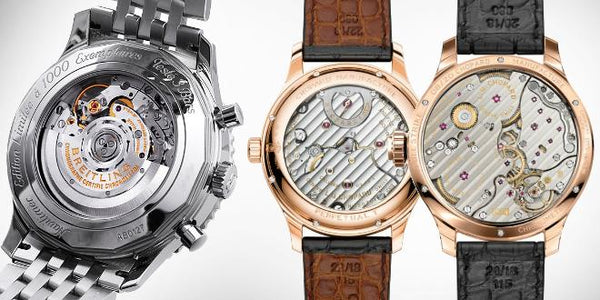
« Why you need them and what they tell us »
Many pocket watches and wristwatches bear engraved numbers or alphanumeric combinations – so-called reference numbers. These codes are of considerable interest above all to watch collectors and enthusiasts of vintage timepieces, because they make it far easier to date a model and assess its authenticity. They also reveal to what extent a particular Rolex, Omega or other luxury watch truly corresponds to its original configuration. This matters because, especially in the pre-owned luxury watch market, pieces keep turning up that are made entirely of genuine parts yet do not reflect any original configuration – for example, because a watch has been paired with a bracelet that, while made by the same manufacturer, was originally only used on other models.
 One number for the watch as a whole
Unlike other numbers that can also be found on watch cases, movements or other components, the reference number always stands for a specific model as a whole. That sets it apart from the case number or the caliber and movement number, each of which refers only to the component in question. Reference numbers should also not be confused with the sequential numbering of individual pieces of a given watch model, which is found more frequently on high-end luxury watches. Such a number does refer to the watch as a whole, but only to one individual piece of the model in question. The reference number, by contrast, serves to identify a specific version of a watch model unambiguously – and every piece of that model version carries the same reference number.
What information does a watch reference contain?
There are no universal rules governing how a watch reference number is structured or what it reveals. Instead, each manufacturer decides for itself how its references are built and what information is encoded in them. As a result, the reference numbers of different manufacturers can differ considerably, even when the models they identify are very similar in appearance and technical specifications.
Regardless of the different coding systems, however, the type of information summarized in a watch reference is usually comparable.
Typical details it can reveal include the type of watch, the case material, the movement, the dial and its design, the hand or hands, and the type of strap or bracelet. Certain features, such as being part of a limited edition or a gemstone setting, can also be derived from the watch reference.
The Omega example
 The following example illustrates what components a watch reference can consist of and what it can tell you: Omega marks its watches with a Product Identification Code (PIC), which can have eight or fourteen characters and provides precise information about each timepiece. In a full fourteen-digit PIC, the first three digits denote the watch model. The fourth and fifth digits indicate the material of the case and bracelet. The sixth and seventh digits correspond to the case diameter in millimeters. The eighth and ninth digits of the PIC identify the movement fitted in the watch along with any complications.
The next two characters reveal which dial was used on the timepiece in question. The last three characters of the code contain the sequence number.
 If an Omega watch carries the PIC 326.30.40.50.03.124, for example, it is a Speedmaster Racing with a 40 mm case diameter and a stainless steel case and bracelet. The dial of this watch is blue, and the sequence number in this example would be 124.
In an eight-digit Short PIC, by contrast, two characters each indicate the product type, the product variation, the dial and the strap or bracelet.
The practical significance of the watch reference
A watch's reference number matters in several ways. First and foremost, it is used in catalogs and sales documentation to identify individual versions of a given watch model unambiguously. If a customer shopping for a particular brand asks for a specific model version that the retailer doesn't currently have in stock, the retailer can order the model the customer wants by its reference – without laboriously listing each product feature, since these are already defined by the reference number. The watch reference is also extremely helpful when it comes to assessing the authenticity and original condition of pre-owned timepieces.
 If a watch connoisseur is offered a Rolex Datejust, for instance, he knows that the manufacturer has released this model in numerous variants over the years. By comparing the reference number on the watch with the relevant information in specialist publications or older Rolex catalogs, he can quickly determine whether the piece is genuinely original or has been assembled from various parts that do not match any historical model version. The reference number, and an understanding of the information it contains, can therefore protect collectors from costly mistakes in the watch market.
Whether the number contains real information, as in Omega's case, or the code seems meaningless at least with regard to the watch's features, and whether it has 14 digits as described or only six, as with Rolex, is of secondary importance. What really matters is that the reference number allows a model to be identified clearly and unmistakably.