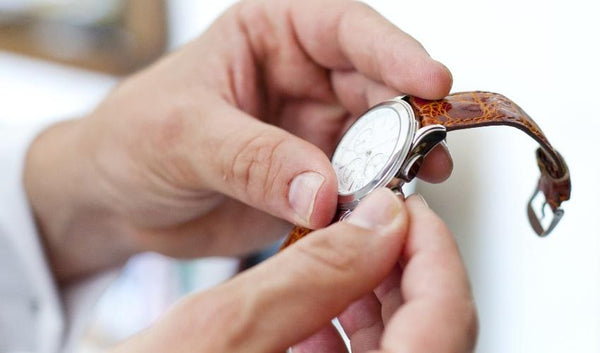
“What does the watchmaker do?”
A car has hundreds of mechanical parts, and regular maintenance is needed to counteract their wear. The same principle applies to automatic and hand-wound watches, which are kept in good working order by professional watchmakers during a service. How often this should be done, how long it takes, what it costs and exactly what steps it involves – we explain it all in the following article.
Watch service: why and how often?
At first glance, regular servicing looks like an extra expense, but in the long run it lowers the running costs of a mechanical watch. The reason: inspecting your timepiece allows developing damage to be detected early, so individual components can be replaced in time rather than requiring an expensive complete overhaul after major defects have occurred. One example: during a service, the watchmaker notices that the gaskets have become brittle and simply replaces them. The alternative would have been the watch failing the next time it went into the water, leaving severe water damage to be repaired. At the same time, a service includes fresh lubrication, which reduces the likelihood of future damage thanks to optimal oiling.

How often a watch needs servicing depends on how it is used. Timepieces worn daily or kept in a watch winder should be checked every three to five years, while occasional wear can go with service intervals of five to ten years. A drop in accuracy is often a sign that a service will soon be due. If the watch has sat unused in a drawer for several years, a service to replace the old oils is also advisable.

Turnaround time and cost
How long a service takes depends on the brand and the complexity of the movement. If you have the work done by the manufacturer (which, along with an official authorized dealer, is the safest option), allow anywhere from four weeks to several months. The average service of Rolex watches is particularly quick: for newer models, the Geneva-based manufacturer quotes 15 working days at its service center in Cologne. An Omega service takes three weeks, while Breitling watches need around six weeks. Historic watches and grand complications can each take considerably longer. Tag Heuer, for instance, quotes five to six weeks for servicing its current models, while vintage pieces can easily take three to four months.


Manufacturers price chronographs and non-chronographs separately. A Breitling service, for example, costs €660 for models with the famous in-house B01 chronograph, while simple automatic models cost €395. Omega charges €550 for non-chronographs, whereas chronographs come to €750. High-end brands such as Patek Philippe are more expensive: servicing a Nautilus can cost up to €2,000.

What does the watchmaker do?
Step 1: Visual inspection
First, the watchmaker scrutinizes the external components of the timepiece to identify any damage and assess what repairs are needed. Is the case scratched? Do all functions operate smoothly? The bracelet or strap, hands, crystal and caseback are also meticulously examined. The advantage: cosmetic damage often provides valuable clues to resulting internal damage that must be taken into account in the following steps.

Step 2: Casing out, dismantling and disassembly
Next comes casing out, i.e. removing the movement from the case. This calls for a delicate touch: not only preparatory steps such as removing the caseback and carefully detaching the crown and pushers, but above all removing the hands must be done with extreme care to avoid damage and scratches. Special storage containers ensure that the delicate small parts are kept safe until the watch service is complete. Once the movement is exposed, it is placed in a movement holder, where it is checked for damage and the next major step is prepared: complete disassembly of the caliber. A simple automatic watch consists of around 60 parts, each of which is taken apart individually. Major complications such as chronographs noticeably increase the number of parts, which raises both the workload and the cost of the service.

Step 3: Cleaning and repair
The now exposed components are individually checked for wear and damage. If there are defects, the affected parts are repaired or, if necessary, replaced. Specific wear parts such as gaskets are replaced by the watchmaker even without visible defects in order to achieve like-new quality and maximum reliability. With older watches, certain spare parts may no longer be available, and the (skilled) watchmaker has to make them in-house. This is an elaborate process that takes time and, depending on the custom part, can be very costly.
Most components, however, are likely to be in good condition and need no replacement. Instead, these flawless parts are professionally cleaned, first by removing oil residue and then by restoring them to like-new condition. This involves special cleaning machines and a basket into which the parts are placed, treated with cleaning agents and finally dried. If requested, the case and bracelet are also thoroughly cleaned using ultrasonic cleaners and gentle soap solutions.

Step 4: Reassembly and regulation
Once all movement parts have been replaced or restored to like-new condition during the service, the caliber must be reassembled in the correct order. At the same time, it is freshly lubricated, which is more difficult than you might think: at least four different oils are used in a typical movement, and each must be applied precisely in the right places. Before the movement goes back into the case, its accuracy is checked using special measuring instruments. If the readings are right, the caliber is cased together with the dial and hands, where it is regulated for the highest possible accuracy. After successful regulation, the watchmaker closes the case – but does not return the watch to its owner right away.


Step 5: Quality control
For at least five days, the timepiece is tested for accuracy in various positions and synchronized with a reference clock. Before returning it to the owner, the watchmaker wants to make sure that all functions work smoothly and that the watch keeps reasonable time. Any errors are corrected by reopening the caseback and fine-regulating the movement.