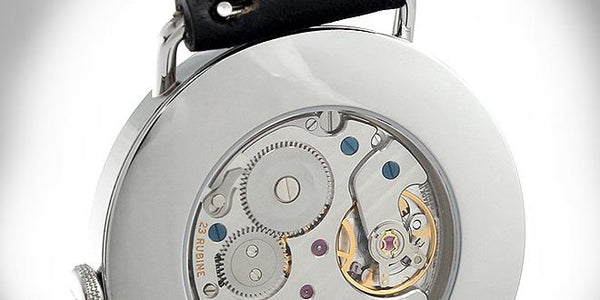
“The Glashütte Movement for Every Occasion”
Over the course of its still relatively short history, the Glashütte watch brand Nomos has invested consistently in developing its own calibers. The result is a family of movements that impress not only with their performance but also with their slim construction. Particularly successful is the Neomatik line, built in several versions for some years now, which we introduce to our readers in this article.
Becoming a Manufacture in 15 Years
The Nomos Glashütte brand is not yet thirty years old, yet among watch connoisseurs it has long been mentioned in the same breath as the other big names from the small Saxon watchmaking town. It has earned this above all through its distinctive design and through intensive research and development that is now bearing rich fruit. When Düsseldorf photographer and IT specialist Roland Schwertner registered the brand name in 1990, there was no way of foreseeing that it would achieve worldwide recognition within just a few years. But the new brand's concept was well thought out.
For one thing, by choosing Glashütte as its home, the company deliberately placed itself in the tradition of one of the most important centers of German watchmaking, a place with a number of superbly trained and experienced specialists who, amid the political and economic upheavals of the time, were looking for new professional prospects.

For another, from its very first watch collection the company developed its own design language and typography, inspired by the Bauhaus and classic modernism, which gives each model a high degree of recognizability at first glance. And last but not least, the engineers and watchmakers at the in-house manufacture worked steadily on developing their own components and movements.

Incidentally, to be allowed to call one of its products a Glashütte watch, a brand must generate at least 50 percent of the value added for the movement in question in Glashütte. At up to 95 percent, Nomos Glashütte is well above that. Its continuous development work meant that, as early as 2005, the company was using only calibers of its own manufacture, earning it a place in the exclusive circle of watch manufactures just 15 years after it was founded. The Neomatik movements are part of this new tradition.
Three Locations and a Host of Hit Models
Today, Nomos is run by founder Roland Schwertner together with Uwe Ahrendt and Judith Borowski. While Schwertner heads sales and Borowski is responsible for the brand and its design, Ahrendt focuses primarily on production in Glashütte.
Production is now spread across two sites, on Glashütte's Erbenhang and in the Schlottwitz district; in addition, there is a third site in the former station building of Glashütte's railway station, which houses the company's administration. Marketing activities are handled by a subsidiary based in Berlin. The first collection, launched in 1992 with the four core models Ludwig, Orion, Tangente, and Tetra, has since been followed by numerous other models that have met with an equally positive response in the market.
Since 2015, the in-house calibers have gradually been fitted with the Nomos swing system and have since carried the designation DUW, for "Deutsche Uhrenwerke" (German watch movements). This also applies to the Nomos Neomatik product line, which includes the DUW 3001 movement from 2015 as well as its various Neomatik successors.
Robust, Versatile, and Impressively Slim: the Neomatik Calibers
When the Neomatik series was launched in 2015, it comprised two different versions each of the Ludwig, Metro, Minimatik, Orion, and Tangente models. All of them were fitted with the DUW 3001, a self-winding movement that Nomos had developed entirely from scratch.

Automatic movements have been available for chronographs for half a century, and for simple three-hand watches for several decades longer. That the models in the Nomos Neomatik series nonetheless caused quite a stir was due less to fundamentally new technology than to their innovative, compact construction.
Comparatively slim, compact cases are as much a hallmark of these watches as the clean Bauhaus-style dial. The slim profile was often achieved by using hand-wound calibers, which as a rule take up considerably less space than a comparable self-winding movement, where the rotor alone demands additional room.

In that light, it is an impressive achievement on the part of Nomos Glashütte that the Neomatik caliber, despite its automatic winding mechanism, could be cased without difficulty in Nomos classics such as the Ludwig, Metro, Orion, and Tangente.
Neomatik: an Automatic Movement with Hand-Wound Dimensions
The Neomatik is in fact a self-winding movement whose dimensions could just as well belong to a hand-wound one. It measures just 3.2 millimeters in height.

That an automatic movement as slim as the Neomatik series' DUW 3001 could be built at all is thanks, on the one hand, to the swing system, an in-house escapement assembly first presented in 2014, and on the other, to the newly calculated gear train.
In addition, new manufacturing methods had been developed for it that would not have been available just a few years earlier.
The fact that the Neomatik movement proved itself in the various classic lines as well as, for example, in the new Minimatik line, and was very well received in the market, motivated the manufacturer to make further modifications. An impressive example is the DUW 6101, introduced in 2018 under the name Neomatik Datum.
Besides the date function the name already suggests, which is based on a mechanism developed in-house by Nomos Glashütte, the Neomatik Datum also features a power reserve indicator. Nomos holds several patents for these two complications as well as for the escapement used in this movement.