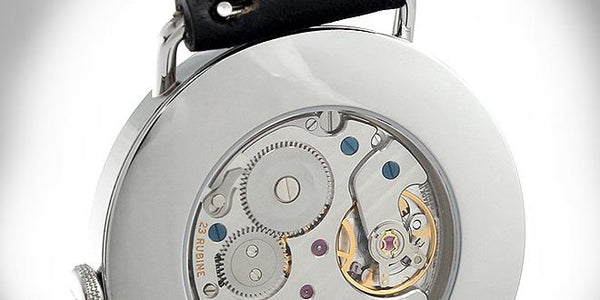
« From ETA to Manufacture »
One of the best-kept secrets of mechanical watchmaking is how to build a precise escapement. Only a handful of companies have the expertise to produce this extremely delicate assembly that sets the beat of a watch. In 2014, Nomos Glashütte pulled off what seemed impossible: after seven years of development and an investment of eleven million euros, the successful Saxon brand launched its own escapement, the Swing System, and gained complete independence in movement production.
What Makes the Escapement So Complicated?
The escapement, also known as the regulating organ or assortment, is both the heart and the most complicated part of a mechanical movement. Audibly recognizable by its characteristic ticking, the escapement gives a timepiece its beat and consists of several components, all of which must be made to the tightest manufacturing tolerances. Otherwise, accurate timekeeping would be impossible.
The main components of the assortment are the balance, the balance spring, the escape wheel, and the pallet fork, complemented by other microscopically small parts. The wafer-thin balance spring in particular, which modern movements increasingly make from silicon for reliability and robustness, demands an immense production effort that only companies with generous budgets can afford. The central challenge is the small size of the escapement in wristwatches – when the assembly is designed for larger timepieces, it is far simpler to execute.
Knowledge from a Bygone Era
When Nomos launched an entirely in-house escapement with the Swing System in 2014, it rightly caused a stir in the watch world. The Glashütte company could not draw on existing literature or mathematical calculations for escapements – the latter simply did not exist. The reasons are historical: when the first quartz movements appeared in the late 1960s, many people in the watch industry believed the mechanical movement had no future. They envisioned an electronic future on the wrist.
[box type="note" align="" class="" width=""]And since many traditional watch companies went bankrupt during the quartz crisis of the 1970s and '80s, no one dared to invest substantial sums in the further development of mechanical escapements.[/box]Survival was the priority. After the quartz crisis ended, the crucial know-how for precise escapements remained with two companies: the Swatch subsidiaries ETA and Nivarox. From then on, anyone who wanted to build mechanical watches had two options: buy safely and relatively affordably from the Swiss monopoly, or take the risk of in-house development with unknown costs.
A 90 Percent In-House Movement Isn't Enough
Given this uncertainty, it is understandable that most mid-range watch brands choose the safe route. In practice, however, this means that many of the manufacture calibers we know are not actually 100 percent in-house developments - while most components are produced, assembled, and tested "in-house," the tiny escapement has to be bought in. Nomos Glashütte was in the same position before the Swing System. Since its founding in 1990, the brand had gradually increased its independence.
First from an aesthetic standpoint - with the timeless Bauhaus designs of its original 1991 collections Orion, Tangente, Ludwig, and Tetra – and then from a technical one. The most important year for the brand was 2005, when it took its momentous step to becoming a manufacture by presenting the Alpha movement. This greatly raised the young brand's standing among experts and contributed significantly to its recognition as an established name in the Glashütte watch world. A full 80 percent of the work on the movement is now carried out in its hometown.
The Nomos Swing System: The Ultimate In-House Technology
For the goal of complete independence from outside suppliers, however, 80 percent is not enough – the escapement of the Alpha movement still has to be sourced from Switzerland. Only the Nomos Swing System would change that. The vision of an in-house escapement was born in 2007, when the watchmaker took on this mammoth task in cooperation with the Dresden University of Technology.
The advantage over earlier decades: complex computer simulations make it possible to calculate the interplay of all the components, which must mesh seamlessly within the escapement. Alongside the design, materials are a central challenge in the Swing System. Nomos received support from the Fraunhofer Institute for Material and Beam Technology in Dresden, which drove the search for modern materials. Key roles on the path to a 100 percent manufacture caliber were played by the young engineers Theodor Prenzel and Lutz Reichel, who took the Swing System from prototype to series production.
"Like Landing on the Moon"
In 2014, after seven years and more than €11 million in development costs, the mega-project was completed. The Swing System celebrated its triumphant world premiere at Baselworld, leaving the industry amazed. Suddenly, Nomos was no longer one of many mid-range brands but part of a small, elite circle of watch companies able to mass-produce their own regulating system. CEO Uwe Ahrendt aptly summed up how significant the step was for the company at the time: it felt like landing on the moon, he said.
[box type="success" align="" class="" width=""]For developers Prenzel and Reichel, the breakthrough was like winning an Olympic gold medal - seeing the Swing System they developed themselves in a store window filled them with great pride.[/box]Speaking of store windows: the technology made its market debut in the hand-wound Metro, followed by its gradual adoption across the rest of the product range. Today, the Swing System is found mainly in the mid-range and top models of the lineup, while most entry-level models are powered by the Alpha.
Which Watches Use the Swing System?
To identify watches with the Swing System, look for the movement designation "DUW": popular hand-wound movements with the in-house escapement include the DUW 4101, used in the classic Nomos Glashütte Metro 38 Datum among others, and the DUW 4401 found in the Tangente Datum Gangreserve.

If you prefer an automatic movement, we recommend the Nomos Glashütte Minimatik and the Nomos Glashütte Metro neomatik – both are powered by the DUW 3001 and stand out for their clean, minimalist aesthetic. Enthusiasts can also enjoy the in-house escapement in automatic watches with the DUW calibers 5201, 5101, 5001, and 6101.


Once you have decided on the Swing System, the big question of looks naturally remains. If you prefer compact watch sizes, you should definitely get to know the Minimatik in midnight blue (Ref. 1205) with its 35.5 mm diameter - if you prefer automatic winding, we recommend the slim 35 mm Metro neomatik (Ref. 1114).
[box type="info" align="" class="" width=""]And if you want to experience the same design in a larger size, the Nomos Glashütte Metro 38 Datum (Ref. 1102) is well worth a look.[/box]